


I am constantly drawn to one theme: how we might re-enchant our world. In preaching, teaching, art, and storytelling, I want to know how we can share what gives life in an increasingly secular age, a world of the “immanent frame,” closed in on itself in a reductionist, materialist doldrum of sterile hallways.
As a preacher, I am always asking how I can speak in ways that do more than convey information. How can I help facilitate an experience of the divine? How can I awaken the imagination of another to the special, numinous, and mysterious quality of ordinary life all around them? Further, I take it as part of the task of any sermon or homily to move the soul. Sometimes it is about feeling more than memory. Sometimes it is better to show than to tell!
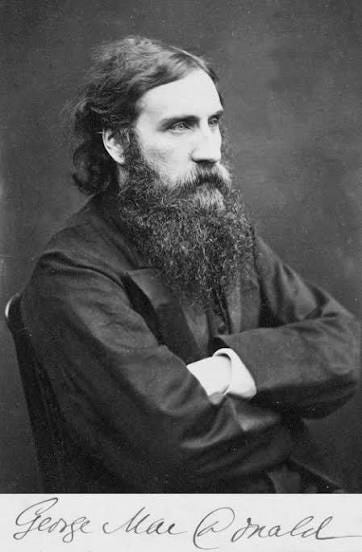
This week, I read “The Fantastic Imagination” by George MacDonald, and I felt as though I had stumbled into words that offered inspiration for my commitment and clarity for my purpose. MacDonald is primarily talking about the fairy tale, but in describing what fairy tales do and what they are for, he seemed to be describing the purpose of any good piece of religious communication, whether art, story, sermon, or song.
MacDonald declares, “The best thing you can do for your fellow, next to rousing his conscience, is—not to give him things to think about, but to wake things up that are in him; or say, to make him think of things for himself.”
Too much preaching aims only to inform. In that way it may be “interesting,” but the aim is surely more formative than that. Information helps with formation, but we must go deeper. Like MacDonald, we must strive to rouse what is already living in each soul: an image of divinity, a spark of imaginative hope or joy, and, beyond these, a primordial longing rooted in a memory deeper than the human brain goes. Our goal is rather to lead humans to sense that we come from somewhere richer than we dare to dream.
MacDonald continues by considering how “nature” works on people. “The best Nature does for us is to work in us such moods in which thoughts of high import arise. Does any aspect of Nature wake but one thought?” Certainly not.
Speaking from my own experience, when I venture into a lovely wood, I hardly ever settle on a single thought, such as the fact of mitosis or meiosis in the life of this or that organism. Nor do I reduce the forest to an incalculable collection of cells. My mind races with delight. I make connections. I laugh at the sounds of a squirrel, and I stand in awe at the stride of a deer. There, I notice the parts of the wood and revel in the whole—it is a whole world filled with light. And beyond sense perception, I feel things deeply: nostalgia, the atmosphere of the moment, wonder, joy. I feel a great deal when I am in the woods. I bet you do too.
Thus MacDonald says, “Nature is mood-engendering, thought provoking,” as a sonata is, or a fairy tale. I argue that religious speech and communication should be the same.
Perhaps the most directly theological of MacDonald’s points is this:
“The one difference between God’s work and man’s is, that, while God’s work cannot mean more than he meant, man’s must mean more than he meant. For in everything that God has made, there is layer upon layer of ascending significance; also he expresses the same thought in higher and higher kinds of that thought: it is God’s things, his embodied thoughts, which alone man has to use, modified and adapted to his own purposes, for the expression of his thoughts; therefore he cannot help his words and figures falling into such combinations in the mind of another as he had himself not foreseen, so many are the thoughts allied to every other thought, so many are the relations involved in every figure, so many the facts hinted in every symbol. A man may well himself discover truth in what he wrote; for he was dealing all the time with things that came from thoughts beyond his own.”
This is a deeply rich notion. God’s thoughts are not contingent; they are perfect and full—and they are one with God. Our thoughts are contingent, and they are made from “the stuff” of God’s thoughts, chiefly God’s creation. And we are merely creatures within creation. As St. Maximus the Confessor reminds us, the one Logos is many logoi: the very mind of God, or God’s reason, is what gives shape and meaning to each unique created thing, and each created thing reveals something of the creator. All things in creation, and all our thoughts, have their source in the givenness of God, and their meaning is bound up in God’s self-disclosure. This means a great deal. But for my purpose here, I simply want to say that when we invoke imagination, wonder, awe, reflection, and so much more, we find ourselves ascending a ladder that, if we have eyes to see, help us to touch and meet with divinity.
How do we accomplish this? That may be worth an essay or a book of its own, but my intuition offers three modest suggestions.
Bathe in story. As communicators and creators, we need to travel in the realm of story and imagination. Doing so shapes our imaginations, and it gives us scaffolding for hanging our own stories. Once we have been apprenticed long enough in the craft, we can break the scaffolding and make our own forms.
Show more than tell. Paint pictures. Relive rather than restate. See with our own eyes what we are referring to, and learn to communicate the truths of emotion.
Refrain from making every point explicit. Let truth live implicitly in lives, stories, moments, signs, and symbols. Leading people to the point is an invitation, not a confrontation.
For MacDonald, the aim of a fantasy story or fairy tale is not simply to give ideas or information. It is to move the reader or listener. So too is the task of religious communication: to move and form the soul into a deeper level of existence. This is why I keep returning to the woods, to the sonata, to the fairy tale, and to the pulpit. This is why I keep reading thinkers such as MacDonald. Each is a doorway, and none of them is the destination. If God’s things are layered with ascending significance, then our task as preachers, teachers, and storytellers is not to exhaust that meaning but to open a door and trust what is already alive in the listener to wake. May our words do less explaining and more awakening, until a world that has forgotten how to wonder remembers that it was enchanted all along.