


Lately, I have been sharing some of the work from a project on monsters that I am working on with my friend Alan Barnes. I’m sharing this piece here because it’s so close to Halloween—and that seems reason enough to indulge in a little reflection on why monsters scare us!
Bestiary—mummies
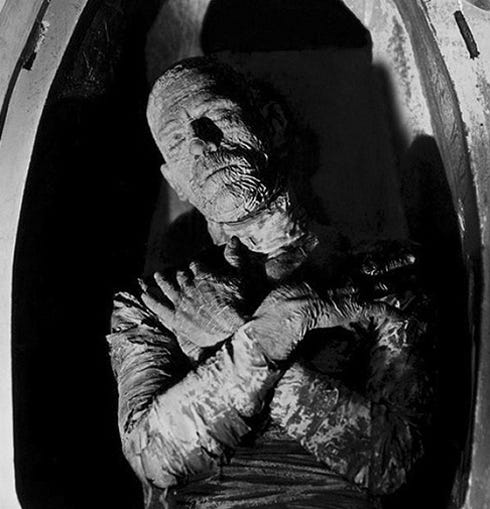
As a boy, I was fascinated by the classic Universal monsters. I loved them, though I was rarely frightened by them. That was especially true of The Mummy.
Years later, I asked my mother what made The Mummy so terrifying when she was a child. She smiled and shrugged. “I don’t know,” she said. “I guess we were just easier to scare back then.”
Her smile told me she understood the problem. It’s difficult to fear a corpse wrapped in old bandages, shuffling along at a snail’s pace, in an age when monsters leap from the shadows, wield knives from razor-fingered gloves, or chase their victims with chainsaws.
Yet perhaps that is precisely why the mummy deserves another look. Monsters rarely endure generations unless they continue to express something true about the human condition. Beneath the dusty wrappings lies one of humanity’s oldest fears.
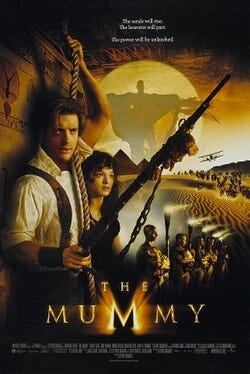
Perhaps The Mummy’s antiquated horror is the reason that the 1932 classic’s remake in 1999 was less a horror film than it was an action-adventure film in the style of a George Lucas or Steven Spielberg summer blockbuster film. But do not let the familiarity or the nostalgia of The Mummy fool you. The creature itself is very much a monster emerging from universal human fear.
Just what is a mummy beyond a bandaged member of the walking dead? In its simplest form, a mummy is a human body intentionally or naturally preserved after death through chemical treatment, freezing temperatures, or other environmental conditions. In other words, mummies are not merely the stuff of horror films—they are historical artifacts. Archaeologists have discovered them in frigid regions where the cold naturally preserved the dead and in ancient cultures that intentionally mummified their deceased as part of their burial practices. Of these, the ancient Egyptians are by far the civilization most closely associated with the mummy.
Unlike other monsters such as vampires, werewolves, or witches, mummies were not monsters in the lore of ancient peoples. Mummies mostly got their promotion into monstrous lore in modernity, especially in the Victorian era.
Several things converged that enshrined this character into the horror pantheon:
Napoleon’s expedition to Egypt (1798)
European Egyptomania
Archaeological discoveries
Colonial looting of tombs
Public “mummy unwrapping” parties in Victorian England
The Victorians literally bought mummies, displayed them in museums and private drawing rooms, and even held “mummy unwrapping” parties where ancient corpses were ceremonially opened for the entertainment of curious guests. Such spectacles reflected Victorian culture’s remarkable fascination with death. Cemeteries were often treated as public parks where families gathered to picnic among the graves. Post-mortem photography preserved the likenesses of deceased loved ones, and inventors even designed elaborate “safety coffins” equipped with bells and other mechanisms in the unlikely event that someone was buried alive. Death was not hidden from Victorian life; it was contemplated, ritualized, and, at times, strangely domesticated.
The Victorian death fetish is the primary reason mummies populated the stories of their vaulted-ceiling salons. This all makes sense, because the Victorian age is one where Science is winning sway over premodern superstition, yet one where so much about death seemed unpredictable. Indeed, death lived everywhere and stopping it seemed so pointless with cholera, typhus, diphtheria making death part of everyday life.
Yet by the twentieth century, the mummy had largely fallen out of fashion. Death still came for everyone, of course, but advances in medical science made it more predictable while dramatically reducing the threat of many once-deadly diseases. The mummy no longer seemed to embody the anxieties of the modern world.
Even so, it is worth noting that in 2026 a new Mummy film reimagines the classic monster, and in 2027 Brendan Fraser is set to reprise his role as Rick O’Connell in The Mummy 4. Is there new life in this old monster of decay?
Perhaps the answer is simple nostalgia. Hollywood has long discovered that beloved intellectual property is often a safe investment, and audiences are eager to revisit the films of another generation. But Lee Cronin’s new interpretation invites another possibility. What if the mummy is returning because it once again speaks to the fears of our age? If monsters survive across generations, it is rarely by accident. They endure because they continue to give shape to the anxieties we struggle to name.
Reflection
So, why do mummies scare audiences? How did the creature lumber into our darkest thoughts? Obviously, mummies touch on a pedestrian human fear—death. The mummy is a character that blurs the line between life and death much like the zombie. And we are never comfortable when that line is blurred.
But there is more to The Mummy than our apprehension of death. Ever notice that mummies are creatures of the past who prey on the present? Perhaps the mummy shows us that there are ways in which our past can be as monstrous as our unknown future!
Mummies evoke the fear of the past returning to haunt us. They also awaken another, quieter anxiety: the fear that we ourselves will one day be forgotten. Beyond that, they stir a numinous fascination with civilizations that remain just beyond our grasp. We have fragments of ancient Egypt and other lost cultures, but only glimpses into their worldview, technology, and beliefs. The mystery itself invites speculation.
One need only glance at the “Ancient Aliens” phenomenon to see this impulse at work. Its proponents often employ what might be called an “alien of the gaps” approach, attributing misunderstood monuments and engineering feats—pyramids, temples, and astonishing stonework—to extraterrestrial intervention rather than human ingenuity. I have no interest here in debating the existence of alien life. My point is simply that the ancient world exerts such a powerful hold on the modern imagination that, in the absence of understanding, we are tempted to fill the gaps with increasingly fantastical explanations.
The mummy is born from that mystery. It is the embodiment of a civilization that still speaks to us, even though we can no longer fully understand its voice.
The past can be monstrous, and it wears many disguises. The mummy is one of them. What lies behind us that we hope to forget? And what have we forgotten that we never should have?
Galadriel captures this beautifully when she reflects on the One Ring in Tolkien’s epic:
“Some things that should not have been forgotten were lost. History became legend. Legend became myth. And for two and a half thousand years, the Ring passed out of all knowledge.”
The mummy is another kind of MacGuffin—a symbol standing in for the things that should not be forgotten. It reminds us that the past is not merely behind us; it continues to shape us, whether we acknowledge it or not. In that sense, the mummy is a profoundly conservative monster—not in the partisan sense of the word, but in the older sense of conserving memory, wisdom, and inheritance. It warns us that a people who lose their past may also lose themselves.
It makes the most sense that people of modernity would be fascinated with mummies as a way of being haunted by the past, because modernity did its best to cut itself off from the past.
Philosophers and historians have noted how unique it is that the modern period was the first period in human history named by its own inhabitants. Typically, epochs are named by later observers, but not so with moderns. The name modern itself means “right now.” It was as if there was a point when the Western intelligentsia said, “ok, that is it, we are modern. We are ‘right now!” Other asked “what does that mean?” “Well,” said the intelligentsia, “it means that whatever we are, we are not the past. And we are certainly not beholden to old ways of thinking or commitments like: superstition, religion, ethnicity, family, or whatever. We are looking only at our future.” The modern imagination makes an idol out of the future and proposed progress. And it does so at the detriment of past knowledge.
Every now and then, a creature from the past creeps up behind a culture obsessed with the future. Modernity, convinced that progress always lies ahead, rarely notices the slow approach of forgotten wisdom until it is too late. Like the mummy itself, the past moves slowly—but it has a remarkable way of catching us.
A profound moral and spiritual lesson from The Mummy is this: do not neglect the past or do so at your own peril. In the realm of theology, specialists neglected the past. Modern thinkers stopped reading Thomas Aquinas as well as some Church Fathers. They only read “manuals” of their thinking. Think “reader’s digest” versions of the great minds. When a movement of thought in 20th century theology started focusing on the primary texts again, it brought the fresh realization that the medieval and ancient thinkers were not only brilliant, but they had considered the same issues and problems we are only now considering—and they have much to say that is useful. We ignore them at our peril.
Colonialism has similarly disregarded indigenous learning. The “more modern” and thus “more advanced” society blew in, assumed the indigenous inhabitants to be barbaric and stupid, and lost so much learning that was gained through generations of living with a place, observing its rhythms, and gently operating within its circular patterns of life and death. A great example of this is ecological lessons of controlled burning. For generations, Indigenous peoples in Australia and North America practiced what is now called cultural burning. They intentionally set small, carefully managed fires that cleared away underbrush, encouraged new growth, and reduced the fuel that eventually feeds catastrophic wildfires.
When European settlers arrived, many dismissed these practices as primitive or even dangerous. In many places, governments outlawed them altogether, convinced they knew better.
But they didn’t.
Over time, forests became choked with dead vegetation. What had once been managed through frequent, low-intensity fires became tinderboxes waiting for a spark. Many of the massive wildfires we see today are, in part, the consequence of ignoring the wisdom of those who knew the land best.
Today, ecologists and land managers are rediscovering what Indigenous communities had understood for centuries. Tribes like the Karuk and Yurok in California are once again using cultural burning to restore forests, improve biodiversity, and reduce the risk of devastating fires.
There is a lesson here that extends far beyond forestry. We have a habit of assuming that the newest ideas are the wisest ideas, or that technological sophistication always surpasses ancient wisdom. But sometimes the people we dismiss as “behind the times” are the very ones who have learned to pay the closest attention. Wisdom is not always found in innovation. Sometimes it is found in humble, patient observation of God’s world.
G.K. Chesterton applies a heuristic when thinking of change and progress. It is often called “Chesterton’s Fence.” He wrote about it in his 1929 book The Thing:
In the matter of reforming things, as distinct from deforming them, there is one plain and simple principle; a principle which will probably be called a paradox. There exists in such a case a certain institution or law; let us say, for the sake of simplicity, a fence or gate erected across a road. The more modern type of reformer goes gaily up to it and says, “I don’t see the use of this; let us clear it away.” To which the more intelligent type of reformer will do well to answer: “If you don’t see the use of it, I certainly won’t let you clear it away. Go away and think. Then, when you can come back and tell me that you do see the use of it, I may allow you to destroy it.
Ignorance is not to be confused with progress. Asking “why” of the ugly or misunderstood fence placement is the first and most wise move of any such reformer. His principle is a middle path between a “let’s always keep it this way” attitude and “change is good because its change” one.
A song that might help us think through the dangers of forgetting and future generations is from Crosby, Stills, Nash, and Young. It is called “Teach Your Children,” and it is about handing down knowledge that is the most important of all:
You, who are on the road
Must have a code you try to live by
And so become yourself
Because the past is just a goodbye
Teach your children well
Their father’s hell did slowly go by
Feed them on your dreams
The one they pick’s the one you’ll know by
Don’t you ever ask them why
If they told you, you would cry
So just look at them and sigh
And know they love you
And you, of tender years
Can’t know the fears your elders grew by
Help them with your youth
They seek the truth before they can die
Teach your parents well
Their children’s hell will slowly go by
And feed them on your dreams
The one they pick’s the one you’ll know by
Don’t you ever ask them why
If they told you, you would cry
So just look at them and sigh
And know they love you
Don’t you ever ask them why
If they told you, you would cry
So just look at them and sigh
And know they love you
Ooh, and know they love you
And know they love you, yeah
And know they love you
But what if we are not only afraid of the mummies in our collective past? What if we are afraid of becoming the mummy ourselves?
That is another layer of the monster’s horror. What if one day we find ourselves alone, surrounded by the artifacts of our lives, while we slowly fade from the memories of everyone else? What if we become relics of a life once lived?
Few works capture that fear more poignantly than Johnny Cash’s rendition of the Nine Inch Nails song Hurt. In the accompanying music video, Cash is surrounded by the relics of his youth and fame. Photographs of loved ones, treasured possessions, and a lavish banquet table all testify to a life richly lived—yet he sits alone among them. As he sings of pain, regret, and memory, the imagery takes on an almost Eucharistic quality. Wine is poured out as though his own life were being offered like a drink offering, and the weight of mortality hangs over every frame.
The song asks a haunting question: What have I become?
It is, in many ways, the question of the mummy.
When Trent Reznor first heard Cash’s version, he famously remarked that the song no longer belonged to him—it now belonged to Johnny Cash. That is because Cash transformed a song about addiction and self-destruction into a meditation on aging, memory, regret, and mortality.
Yet even after the music fades, the deeper question remains: What happens when we begin to feel like the mummy—surrounded by the things we spent our lives accumulating, yet increasingly forgotten by the world around us?
The gospel offers a different way.
It reminds us that the measure of a life is not found in what we preserve but in what we give away. We are remembered not because of the possessions we leave behind, but because of the love we have shared, the lives we have touched, and the treasures we have stored where neither moth nor rust can destroy them.
Jesus put it this way:
“Do not store up for yourselves treasures on earth, where moth and rust consume and where thieves break in and steal; but store up for yourselves treasures in heaven, where neither moth nor rust consumes and where thieves do not break in and steal. For where your treasure is, there your heart will be also.” (Matthew 6:19–21)
The mummy spends eternity clinging to what remains of the past. Christ invites us to invest ourselves in a future that death cannot steal. The mummy is wrapped in grave clothes, trying desperately to preserve what is fading away. The risen Christ leaves his grave clothes behind.
That is the final lesson of the mummy. Our hope is not found in preserving ourselves. It is found in resurrection.