


I have been working with a friend, Alan Barnes (artist, comic book author, and musician) on a sort of “bestiary of monsters.” Think of it as a codex of some of the most famous monsters we have created to scare us. It will have art, stories, and theological/ethical reflections on the monsters. Here is a sample, and it is all about The Inivisble Man!

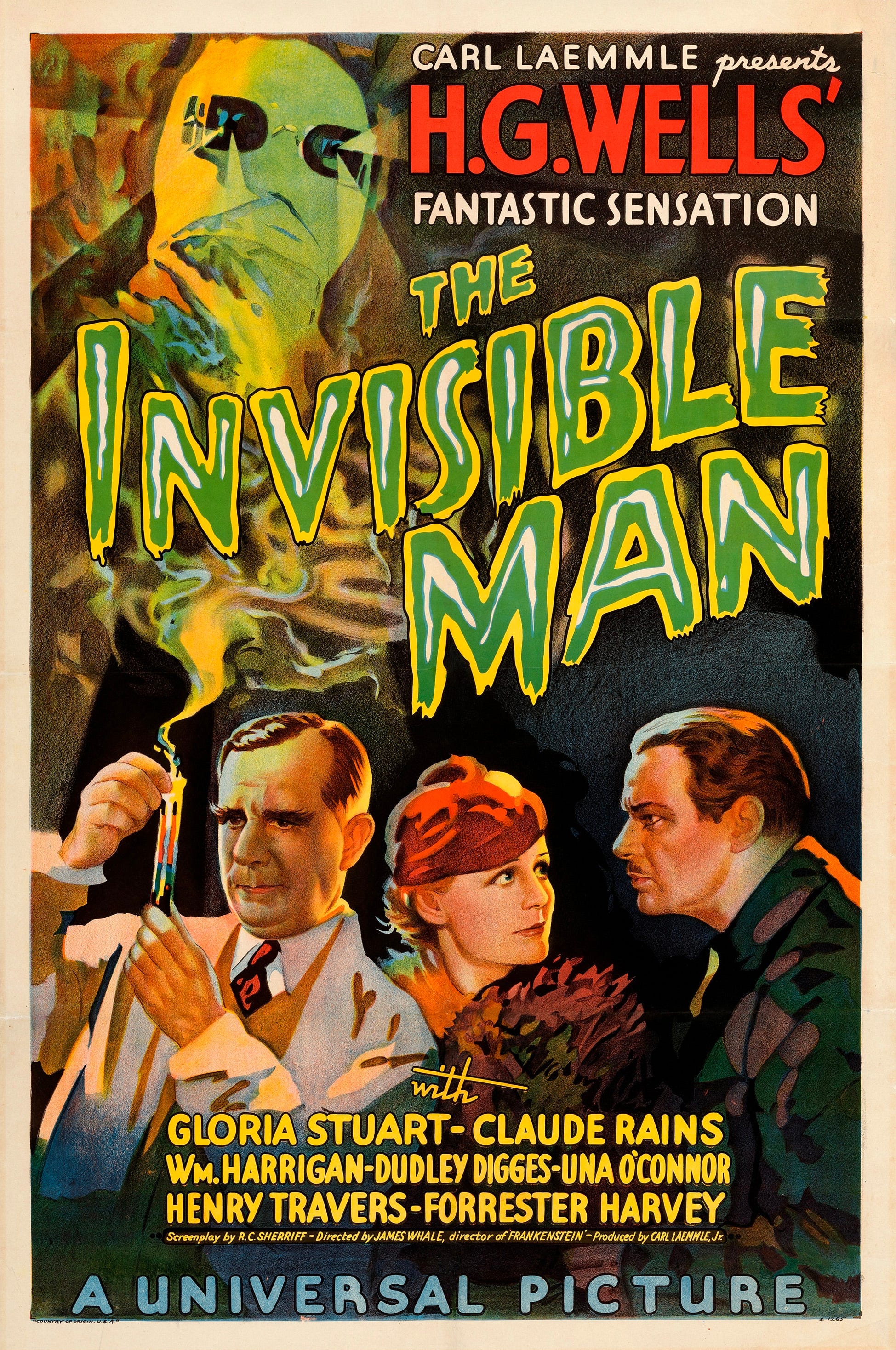
We have all seen an invisible man story or two. Film devotees will remember Claude Rains in James Whale’s 1933 Universal monster picture The Invisible Man, adapted from H. G. Wells’s 1897 novel of the same name. Others will fondly point to the “monster of the week” episode of Buffy the Vampire Slayer, “Out of Mind, Out of Sight” (1997). In it, a high school student named Marcie Ross begins to disappear, her body following her sense of isolation. She turns to unconscionable acts, until men in 1990s FBI suits arrive to take her to an undisclosed school for assassins.
Marcie’s is not the only story that ties invisibility to moral corruption. Think of the One Ring in Tolkien’s The Lord of the Rings. It makes whoever wears it invisible: Isildur, Gollum, Bilbo, Frodo. (As if anyone could hold power over so corrupting a force.) In the end it makes monsters of its bearers by turning them inward, toward lower and lower forms of existence. Gollum is what remains of a person after nearly five hundred years of hiding. And this is the power of the invisible man trope: it asks what we would do if no one were looking.
Leigh Whannell’s The Invisible Man (2020) boldly reworks Wells’s story. It moves the focus away from the invisible man and onto the person forced to live under his invisible power. Cecilia Kass (Elisabeth Moss) escapes her wealthy, brilliant, violently controlling boyfriend, Adrian Griffin. Soon after, she learns that he has apparently taken his own life and left her a fortune. But strange events convince her that Adrian has built an invisibility suit and is stalking her. Because no one else can see him, people dismiss Cecilia as traumatized or unstable. Adrian uses that disbelief as one more weapon, attacking the people around her and finally framing her for her sister’s murder. When Cecilia at last fights back and the man in the suit is unmasked, he turns out to be Adrian’s brother, Tom. Adrian then resurfaces, claiming he was held captive the whole time, and the question becomes whether he was ever really out of the picture. In the final scene, Cecilia puts on a second suit, turns Adrian’s own methods against him, and stages his death as a suicide.
Whannell’s version works so well because it turns Wells’s science fiction into a story about invisible power. Wells asks what a person would do if he could act without being seen. Whannell asks what happens when someone who already has power over you also becomes literally unseen. The horror isn’t simply that Adrian can disappear. It’s that Cecilia cannot prove what is happening to her. Invisibility becomes a metaphor for domestic abuse, coercive control, gaslighting, and the experience of not being believed. Whannell keeps his monster almost entirely off-screen, and the film’s dread comes from the empty corners of the frame where he might be standing. Even Cecilia reaches for the suit in the end, a reminder that the power to go unseen tempts the wronged as well as the wicked. For all its freshness, the film is still working on the old question: what will people do when no one is watching?
That question is far older than Wells. Its most famous form comes from Plato. In the Republic, Glaucon challenges Socrates to prove that justice is worth having for its own sake, not just for its rewards. He tells the story of a shepherd, the ancestor of Gyges of Lydia, who finds a ring that makes him invisible. Before long the shepherd seduces the queen, murders the king, and takes the throne. Anyone given such power, Glaucon argues, would do the same, because no one is just willingly. The thought experiment asks a basic question: are we good because we desire justice, or because we fear getting caught? Plato spends the rest of the Republic answering it. Justice, he argues, is the health of the soul, and so it is good even when unseen. Tolkien’s ring reads like a long, haunting reply to Glaucon.
The Lessons of the Invisible Man
These stories make us ask whether our acts of justice come from real care for the good or only from concern about how others will see us. Is morality a social construction held in place by communal shame, or is it written on the human heart? It is an endlessly fascinating question, and it easily brings God into the conversation, since a believer can always answer that we never escape God’s gaze. But that answer raises questions of its own. Is God a kind of panopticon, like Jeremy Bentham’s prison where inmates behave because they might be watched? Is that kind of watching enough to keep us in moral check, enough to keep us human and save us from the monstrous? Or is it easy to ignore a God who sees us when we cannot see God?
What I find most interesting in the motif comes through most clearly in the Buffy episode, and it is all about personhood. Everyone ignores Marcie Ross, and that neglect becomes her physical invisibility. People treat her as a non-person until she nearly becomes one. This lands because almost all of us have felt invisible somewhere, especially in high school. From there Marcie declines, like Gollum, into a parasitic existence, living in the crawlspaces of other people’s lives, until she loses her personhood altogether.
Notice the difference. Gyges, Griffin, and Adrian seize invisibility. Marcie and Cecilia have it forced on them. The first is the sin of the powerful who hide. The second is the sin of a community that refuses to see. Both end in monsters.
In the Christian tradition, as in others such as African Ubuntu (“I am because we are”), personhood is defined by relationship: with oneself, with God, and with others. Self-disclosure, being known, is what makes a person. Every version of the trope, from Glaucon’s shepherd to Whannell’s Adrian, asks how much of a person we can remain when we withdraw and hide from one another, or when others hide us away.
Being seen is a basic human need. The Doors sang about how strange people seem when you’re a stranger, “people are strange when you’re a stranger, faces look ugly when you’re alone.” Simon & Garfunkel sang of people who talk without speaking and hear without listening, “People talking without speaking, People hearing without listening.” This is why communities matter. And it is why it matters theologically to remember that we are seen in our innermost depths. Hagar, a slave woman whom no one else saw, was the first person in Scripture to give God a name: El Roi, “the God who sees me” (Genesis 16:13). It matters so much that I will end with another song as a benediction:
Psalm 139 KJV:
Psalm 139
1 O LORD, thou hast searched me, and known me.
2 Thou knowest my downsitting and mine uprising, thou understandest my thought afar off.
3 Thou compassest my path and my lying down, and art acquainted with all my ways.
4 For there is not a word in my tongue, but, lo, O LORD, thou knowest it altogether.
5 Thou hast beset me behind and before, and laid thine hand upon me.
6 Such knowledge is too wonderful for me; it is high, I cannot attain unto it.
7 Whither shall I go from thy spirit? or whither shall I flee from thy presence?
8 If I ascend up into heaven, thou art there: if I make my bed in hell, behold, thou art there.
9 If I take the wings of the morning, and dwell in the uttermost parts of the sea;
10 Even there shall thy hand lead me, and thy right hand shall hold me.
11 If I say, Surely the darkness shall cover me; even the night shall be light about me.
12 Yea, the darkness hideth not from thee; but the night shineth as the day: the darkness and the light are both alike to thee.
13 For thou hast possessed my reins: thou hast covered me in my mother’s womb.
14 I will praise thee; for I am fearfully and wonderfully made: marvellous are thy works; and that my soul knoweth right well.
15 My substance was not hid from thee, when I was made in secret, and curiously wrought in the lowest parts of the earth.
16 Thine eyes did see my substance, yet being unperfect; and in thy book all my members were written, which in continuance were fashioned, when as yet there was none of them.
17 How precious also are thy thoughts unto me, O God! how great is the sum of them!
18 If I should count them, they are more in number than the sand: when I awake, I am still with thee.
19 Surely thou wilt slay the wicked, O God: depart from me therefore, ye bloody men.
20 For they speak against thee wickedly, and thine enemies take thy name in vain.
21 Do not I hate them, O LORD, that hate thee? and am not I grieved with those that rise up against thee?
22 I hate them with perfect hatred: I count them mine enemies.
23 Search me, O God, and know my heart: try me, and know my thoughts:
24 And see if there be any wicked way in me, and lead me in the way everlasting.