


So Donald Trump is going to sell Patriotic Bibles. What is a patriotic Bible, you ask? Beats me. I am sure the inner logic of the contents of the scriptures prohibit such a thing, but I suppose the inner logic probably runs contrary to the consumerism associated with the many special interest Bibles. I cannot say that I am surprised. Trump has continuously made use of certain streams of Christian faith for his own purposes; those purposes to my mind were almost always about power, but in this case it seems to be a cash grab…probably in the pursuit of more power.
This all reminds me of a text that I love by Merold Westphal Suspicion and Faith: The Religious Uses of Modern Atheism. In the text, Westphal advocates reading atheism for lent. Though I know it sounds shocking and I have had more than one conversation with scholars who are wise beyond words that expressed concern for this, Westphal’s point is interesting to me. He claims that the masters of suspicion (Marx, Freud, Nietzsche, and Feuerbach) tout an atheism that runs deeper than many late day atheists. What makes them masters of suspicion is not that they sit around debating facts, or historical reliabilities, or even issues of science vs religion. No, they are rather suspicious of what makes believers believe. Do you believe because it adds power to your life? Do you have faith because it serves your ends? Does piety serve as a sort of wish fulfillment or an opiate to numb you from the cold hard truth of reality. In short, theirs is a psychologically and existentially probing method of questioning—and it becomes personal. They aim to reveal when a religion is not truly an authentic faith response to a divine experience, but rather is an instrument for power, control, or self-aggrandizement.
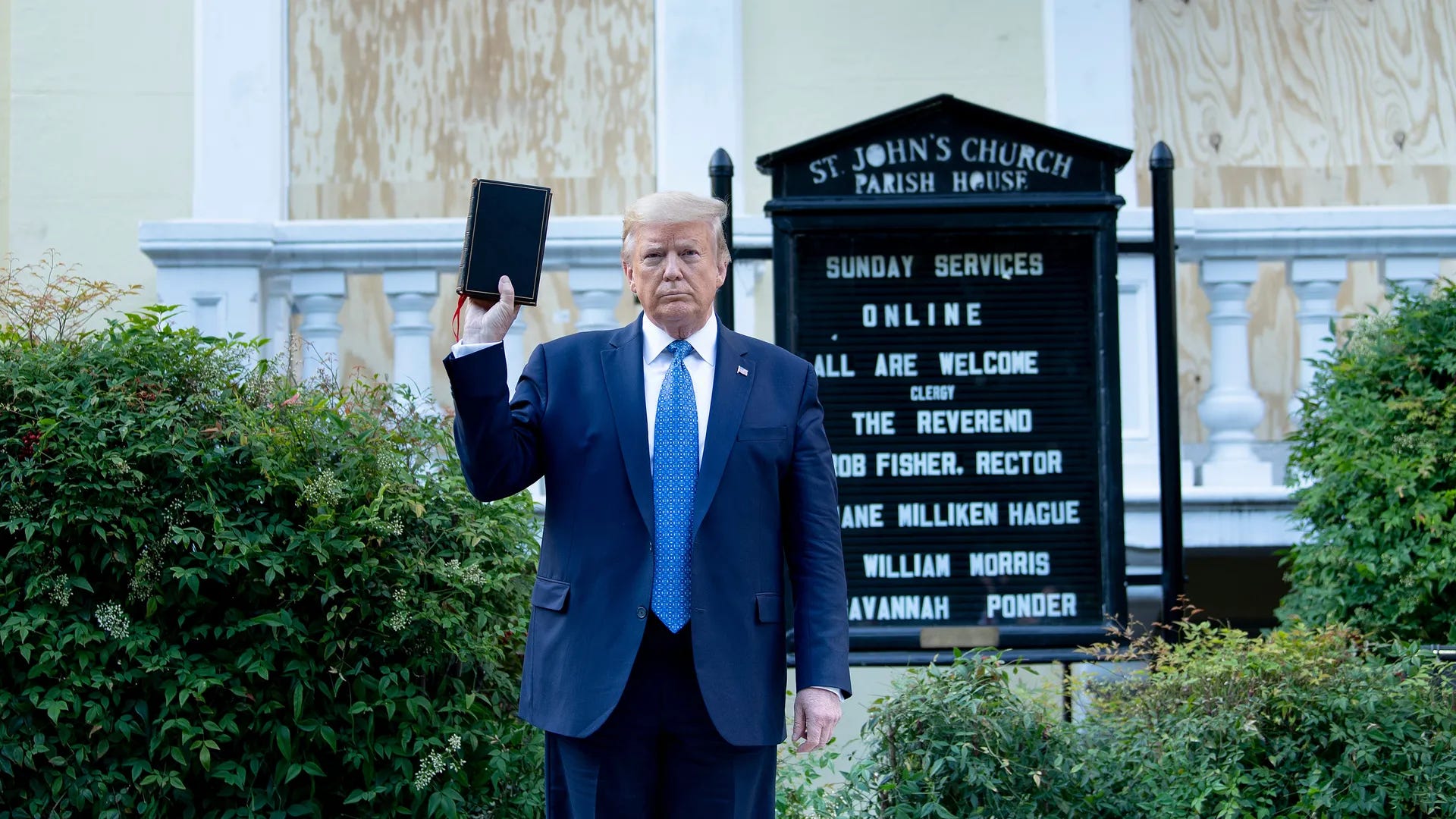
I assume these masters of suspicion would be foaming at the mouth, champing at the bit to be let loose on a character such as Trump who is in bad financial shape, and needs to keep certain strands of Christian community happy, as he has now taken to selling something as blatantly idolatrous as a patriotic Bible. He has already used the Bible, at least once, in such an egregious show of instrumental religion. Remember that? Do you remember the fracas near the White House, when Trump marched across a street, stood in front of a church, and quite angrily held up the Bible (upside down, I believe) to signal something to his audience?
So many have been asking what I think of the patriotic Bible deal he is up to now. All I do is shake my head and say, “what else did we expect, this is who he is and who he has always been!” But it does call to mind a film I watched sometime ago, and I commend it to you all. It is called The Book Of Eli. It is a post-apocalyptic tale where a person played by Denzel Washington walks the world on a mission to carry a book toward an undeclared destination. Along the way he encounters warlords, and fiefs who wish to gain more power. One such leader is played by Gary Oldman, his name is Carnegie. Carnegie is literate whereas most of his fiefdom is illiterate. Still, he sends out war parties to collect books for him to look through. There is one book he wants. But how are they to know when they find it, they cannot read after all? He makes the sign of the cross with his fingers to show them what the book will look like.
As the clip reveals, Carnegie does not wish to find a Bible as a rule for his faith, or as a comfort for journeying with God in hard times. Nor is it to be a book of wisdom and instruction for virtue. Rather, the Bible has a certain power. It can elicit devotion, commitment, and allegiance (making it a strange bedfellow to wed with patriotism or worse…nationalism), and Carnegie knows this more than anyone else.
The reality is that the Bible has been used for good reasons and for bad ones. People of faith have danced with those in power, and we have been on the brutal end of other’s power. The Bible has been weaponized and it has been a source of others healing. This reality not to mention other ways we have instrumentalized religion/spirituality/faith/the church reminds me that today’s NONES, and today’s younger generations have well formed meters for power, abuse, and inauthenticity. Religious expression that is ripe for our moment and is ready to live and be deployed in a time of church decline must be free of instrumentality. It must be earnest (even for generations that enjoy aesthetic cynicism), honest about its motivations, and it must be aware of the ills of the world as well as the ills of the heart of the faithful.
What do I think of Trump’s desire to sell patriotic Bibles? Maybe this debacle is what we deserve? Maybe he is reflecting who we are? Maybe we should be better and thus expect better. Or maybe it is a lesson for us to always check our intentions. Let us ask ourselves: is our faith instrumental, or is it sincere movement in faith in response to what God has done?