


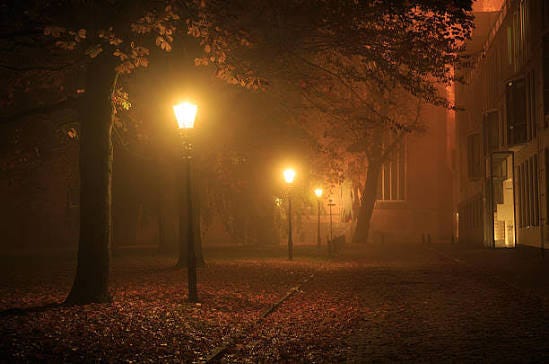
The other night, I drove my daughter home from an event. The dark autumn nights are now crisp, and the light from homes, streetlights, and human doings at such an early hour reminds us that we are now in the dark part of the year. Winter is coming, and as the brisk mornings and evenings suggest, we are also entering the cold season. Halloween is over, and as we drove, my daughter bemoaned the fact that people were taking down Halloween decorations and following them up with Christmas, with no time and no space between the two. Thanksgiving, she thought, gets overlooked. I grunted in agreement.
But it also got me thinking about how modern life has changed the deeply historic and mythical ways we have socially imagined our calendar year. In this day of late capitalism and consumerism, we now call all of October “spooky season,” a time when it is socially acceptable to decorate with spooky things, watch scary movies, and even indulge our curiosities about death. I guess on November 1 (still All Saints’ Day, I might add) we throw that aside and begin “Christmas season,” to say nothing of All Souls’ Day, Thanksgiving, or the preparation time for Christmas: Advent. But I am not going to go into all of that calendar storytelling. I want to talk about what I told her.
I told her that in premodern times (encompassing parts of the Christian epoch as well as pre-Christian ones) it might be more appropriate to call this dark and cold season “spooky season.” Halloween marks the beginning of the season, not the end. That is because Halloween marks the harvest and the beginning of winter, and in premodern times this was the most dangerous time of year. The sky is darker longer, the temperature gets dangerously cold, whatever you managed to bring in during the harvest had better last until spring, and everything that heightens the delicate and tenuous nature of life is more present than at other times in the year. Is it any wonder that this season, from Halloween through the winter, has been marked mythically by ghost stories, lore, and folk tales that could all be called spooky? The atmosphere is ripe for all of it, but so is the existential situation of people without heaters, electric lights, refrigeration, and antibiotics.
My daughter simply replied, “Well, it does feel creepy out here tonight.” I smiled and said, “Sometimes it does.”
I then told her that there is a rich tradition of Christian ghost stories. That surprised her. It surprised her even more to learn that, especially in Britain and British-influenced countries, there is a strong tradition of Christian Advent ghost stories in which the ghosts come back with messages to wake the living up to their sleepy, unintentional, or downright unjust living. The most famous, of course, is Dickens’ “A Christmas Carol.” And you will recall the line from “It’s the Most Wonderful Time of the Year” referring to “scary ghost stories,” no doubt. I used to wonder what that was all about. Apparently my daughter did too. Well, it is about the tradition of Advent and Christmas ghost stories.
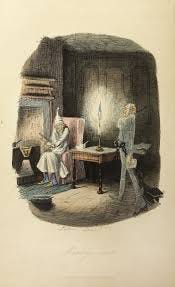
It makes sense liturgically and spiritually, especially when you let Advent be Advent and not an extension of “Christmas time.” In Advent we are told that we are in the dark, awaiting a great light. In Advent we remember the dead and we honor the waiting of the saints of old. In Advent we confront judgment while we await a supernatural intervention into human history. I guess all of this storytelling, situated in a culture (the northern hemisphere) that is in its cold and dark time of year, can naturally turn people’s minds to the spooky, the dark, and the more ruminative thoughts we tend to have.
This year for Advent I plan on reading a few ghost stories. I am considering M. R. James’s “Ghost Stories of an Antiquary,” and perhaps Addison Hodges Hart’s (priest and theologian) “Patapsco Spirits: 11 Ghost Stories,” just to lean into the historical and mythical realities associated with our darker and colder months.
If you have moved from Halloween on to Christmas, let me assure you I have no quarrel with you. Nor does my daughter. We do hope you take the time to properly enjoy Thanksgiving and Advent. But I do ask everyone to try to think beyond the veil of modern technology and modern rushing about. Realize that we are still in “spooky season,” in that we are in that time of year that is colder, darker, and slower, a time when it is much easier to contemplate death and our mortal reality.
By way of conclusion, let me make some practical suggestions for ways you can accept the natural and mythical rhythms of this part of the year and avoid the dizzying displacement that modern technology and rushing about do to our sense of self, time, and creatureliness.
First, you can use lanterns and candles in your home at night. Resist driving out the night by quickly switching on a light in a room. It is a modern miracle that we can chase away the night so quickly, but it can lull our bodies into the illusion that it is not as late in the day as it really is.
Second, you can eat more seasonally and slow your eating and food-preparing rhythms into a prominent point in your day. Eating should be a “tent pole” in the day, and you can do this by being more intentional with what you prepare and how you prepare it.
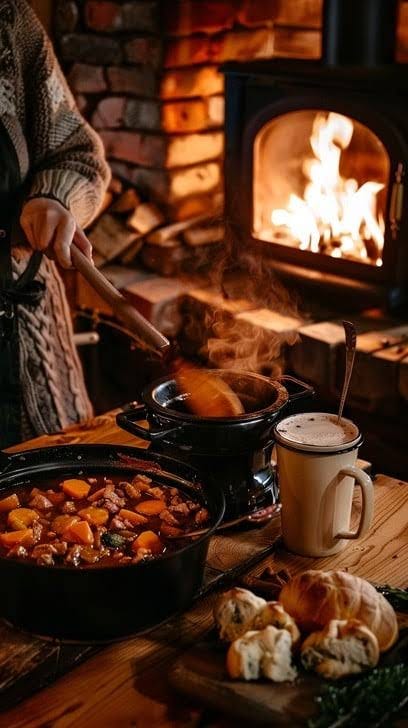
Next, lessen your screen time. Take moments to go outside and simply “be” in the cold, dark, and twilight times. Become more intimate with your surroundings. While the screens are off, try reading a book or a poem. Maybe try a little writing. Try to pen a ghost story or two. I think this is especially beneficial with the sound of a nearby fire and the constant ticking of a wall clock. Those are things that make you aware of time in a way that binging a television show steals from you.
Finally, try to imagine just how blessed you are to have provisions. Do the reflective work so you can truly see how unique you are to live in a time of abundance, refrigeration, heat, and so on. So, I guess I would end by suggesting you offer profound and sustaining moments of gratitude for your home, your food, and the warmth of all in your care.
Happy spooky season.
This is a lovely post. We went to see Ebenezer this last week. Truly different adaptation from the highly comic versions. A depth of serious and reflection and really gothically scary at points. Not horror, but true gothicism. I liked it very much in spite of the criticisms in the press reviews. It may become one of my favorite adaptations of A Christmas Carol. Soon it will be time for Latkes, applesauce, and sour cream as well. Winter has delights for everyone, along with the fears brought by its cold winds.