


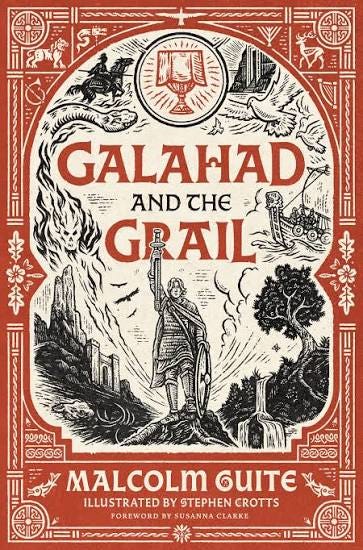
I have just finished reading Malcolm Guite’s recent work, Galahad and the Grail. Written in ballad form, Galahad is the first offering in Guite’s attempt to bring these old stories to life for a new generation. It is beautifully published by Rabbit Room Press, and every book should be made with such care. The binding, the paper, the ink and typeface, and the illustrations are all exquisite. Yet they only adorn the exquisite rhyming narrative Guite weaves. His chief aim, I gather, is to help us re-enchant the world through the old stories.
Guite uses a phrase, both in Galahad and elsewhere, for rescuing modern, Enlightenment minds from the immanent frame by opening them to transcendent truth, so that enchantment becomes both the language we speak and the lens through which we see. That phrase is “lifting the veil.” And what can I tell you, except that reading this book helped lift the veil from my own imagination once more?
I delighted in the tales of questing, knights, chivalry, and heroism. But none of it compared to the way virtuous deeds, guided by faith, hope, and love, made barren lands live again. These quest stories do not have human glory or manly power as their end. Instead, they show how a human life given to virtue can make desolate places breathe again with fresh winds and restored vitality. These are places given over to “un-creation” (see Romans 8).
I have been reading this tome aloud to my seven-year-old son, Max. It takes a lot of explaining, but it gives us a chance to luxuriate in the beauty of a poet’s language, and in the process the boundaries of our imaginations are stretched together.
I also listened to it on Audible. Why? Because Guite carries himself like an English hobbit, complete with beard, waistcoat, pipe, and ale. He also has a lovely English accent and a worldly timbre. Hearing him read his own text felt almost liturgical, a kind of leading in worship, even as I drove through rush-hour traffic.
The book closes with several appendices. These are essays on the Arthurian source material, on the imagination of authors such as the Inklings, and on how Guite sees Christianity in and through these Arthurian tales and their history. They alone are worth the price of the book.
Obviously, dear reader, I am recommending this book to you. It is fascinating. If you love the Arthurian legends, enjoy the rhyme and meter of the ballad, and are ready for adventure, this book is for you.
But if you have followed my writing here, you will recall my longing for a kind of communicating, storytelling, and teaching that re-enchants the imaginations of our audiences. I often ask how we can do that, and I often offer tips and ideas for the task. I am happy to report that one way to do it for yourself is to read books like this one. It is not simply that Galahad is a premodern adventure tale. It is also that it comes from someone like Guite. He shares a purpose with Martin Shaw, Norman Wirzba, the Inklings, Paul Kingsnorth, Rachel Carson, Winona LaDuke, and so many others: to introduce you to the something more, the enchantment of the world.
It strikes me as a bit funny how many people set up a dichotomy between imagination, enchantment, and the transcendent on one side and ethics, justice, and social responsibility on the other. The dichotomy is false, and it is destructive.
My own testimony is this: when I read enchanting tales of a world alive, I am drawn toward acts of virtue, courage, and hope. Those are the ingredients of any work of justice. Reading alongside people like Guite and striving for enchantment is not an escape from a world in need of justice. It is how we armor up and make ready for the task!
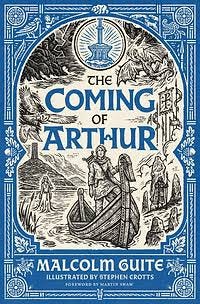
I have preordered the next installment: The Coming of Arthur, and I anticipate it greatly as my imagination is stretched and my sense of calling deepened. Keep walking my pilgrim friends!