


In a recent post, I offered nine reasons (the ones I could think of) why the Christian Church (Disciples of Christ) has been among the fastest-declining denominations of the mainline. One of those reasons was identity. I aimed that critique at the Disciples, but in some ways it applies to the wider Stone-Campbell tradition too: the independent Christian Churches and Churches of Christ, and the Churches of Christ, most of them a cappella.

The identity confusion I wrote about is this: we fancy ourselves a “big tent church.” Our movement has been driven by unity since its beginning, so we picture ourselves as a big tent where almost anyone can find shelter. My first critique is simple. If the first thing you can say about yourself is that you are a big tent, then you cannot be much of anything in particular.
From conversation and experience, I gather that fans of the “big tent” idea mostly mean that we have an open communion table where everyone is welcome. That is true, and it matters. Our tradition was unusual in opening the table to Christians of other traditions and denominations. But that practice is no longer as distinctive as it once was. Many churches now have an open table, and you cannot throw a rock without hitting a church that is all about “welcome” and “belonging,” a place where everyone can find their place.
To me, the big tent, or the open table, is at best a wing of our identity, a secondary marker. What comes first is our near-sacramental commitment to baptism and the weekly practice of the Lord’s Supper. Those practices set our tradition apart among non-Catholic churches. Spoken of rightly, they could make us something like an American via media, a middle way between the sacramental churches and the free-church evangelicals. They grow out of the tradition’s commitment to the basics of church life as we understand them through Scripture. Some call this “primitive Christianity,” others “New Testament Christianity,” and still others simply being “an Acts church.” Because our other great impulse was unity, it makes sense that we leaned into the logic of the open table, finding ways to eat together across differences of opinion.
Some may think my dismissal of the “big tent” label goes against the very foundation of our tradition. I would say I simply want language that keeps us from getting lost in ambiguity, and our tradition, especially the Disciples, slides into ambiguity easily. So I want to offer another way of thinking about the big tent and the open table. I learned it years ago from a layperson in my church.
I had just finished all the acrobatics of description and logic it takes to explain who we are. You know:
We are committed to the New Testament expression of the church.
We are committed to unity.
We are sacramental about baptism and the Lord’s Supper.
And then the big one: In essentials, unity; in opinions, liberty; in all things, charity.
He listened to all of it and said, “Oh, I know. We’re a Mere Christianity church.”
I asked what he meant.
“Mere Christianity,” he said. “You know, like C. S. Lewis wrote about.”
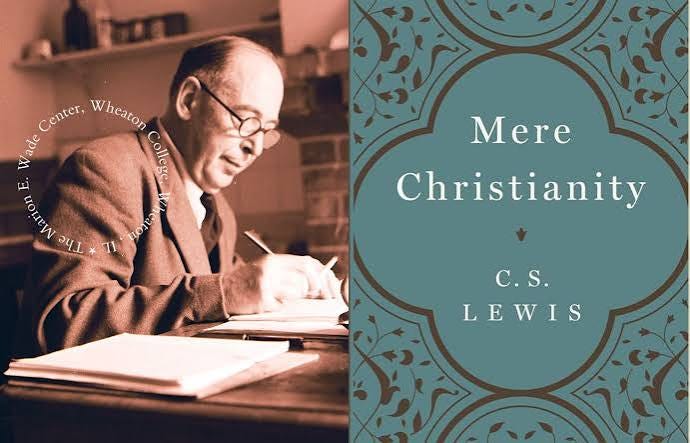
In that famous book, Lewis set out to describe what is “merely” Christian: the faith in its most basic and universal form, the thread that runs through every tradition of the church. Take the atonement. Lewis doesn’t settle the debates over how Christ’s death saves us. He insists only that it does, and he treats the competing theories as secondary. Elsewhere he observes that at the spiritual center of each tradition, among its most faithful people, the communions are closest to one another, closer in spirit even when they remain apart in doctrine.
Isn’t that what we have been reaching for with “big tent,” or “open table,” or “in essentials, unity”? I prefer my parishioner’s phrase because it is clear. We do not accept everything. What we care about is what is merely Christian. We major in the foundations. Beyond them there is plenty of room for opinion, nuance, and disagreement. N. T. Wright updated Lewis’s idea for a new generation as Simply Christian, and that is our stuff: the simply Christian things.
Lewis famously described mere Christianity as a hall with doors opening onto many rooms. The hall, he said, is a place to wait, not to live, and the fires, the chairs and the meals are in the rooms. Fair enough. But if the Stone-Campbell tradition is a room, it is one furnished almost entirely from the hall, with its door propped open, and the meal is on the table every Sunday.
That commitment, I maintain, makes our tradition unique on the American church landscape. It is worth holding on to.